
Building collaboration with trade unions and civil society in Thailand
Electronics Watch and partners in the ElectroPower project held workshops for trade unions and civil society organisations to increase collaboration, and delivered training for migrant workers
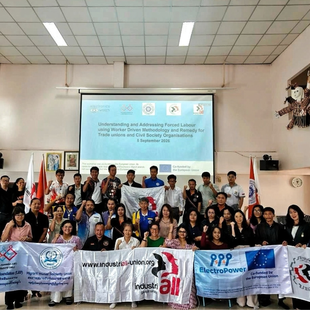
As part of the EU-funded ElectroPower project, Electronics Watch recently delivered labour rights training for migrant workers and organised a cooperation workshop for trade unions and civil society organisations in Thailand. Both were organised jointly with our Thailand-based monitoring partner the Labour Rights Foundation (LRF), and IndustriALL Global Union.
The ElectroPower project works against forced labour and towards fair and safe working conditions in the electronics industry. It does so through targeted support for trade union organising activities and strengthening of collaboration between them and civil society organisations (CSOs). Via monitoring of electronics factories and smelters, ElectroPower will facilitate remediation for workers based on the Electronics Watch impact model. The project is also working on the development of grievance mechanisms, and the strategic use of public procurement as a lever.
Omana George, Electronics Watch's monitoring and civil society engagement manager, was in Thailand for the trade union/CSO workshop on 5 September in Chachoengsao province. Some organisations have set up regular coordination meetings to work together more effectively, and the group discussed how they could improve their joint interventions when it comes to capacity building, research, legal case consultation and sharing existing resources. Project grant recipients are already collaborating in areas like training, case work, and information sharing, and the workshop helped to consolidate some of the progress they have made so far.
The participants endorsed a declaration to strengthen practical cooperation and mutual support. It sets out the objectives and joint activities that trade unions and CSOs will follow to prevent and address forced labour, protect workers' rights, and ensure access to remedy. It represents an important step forward since the start of the project, with different organisations now more aligned and with a solid understanding of each others' work.
The migrant worker training took place the following day in Chon Buri province, beginning with an evening session for Burmese migrant workers. The workshop introduced ElectroPower, LRF, the Migrant Workers Solidarity Committee (MWSC) and IndustriALL Thailand. It was followed by a full day session familiarising migrant workers with forced labour and how to identify it, as well as planning the next steps for monitoring jointly with the workers.
ElectroPower also has a research element, led by Olga Martin-Ortega, Electronics Watch's senior advisor on remediation in global supply chains. She held interviews and focus group discussions with trade union representatives, as well as interviews with LRF staff, migrant workers from seven electronics factories and CSOs who are working on forced labour issues. She will be sharing updates on her research at Electronics Watch's regional event in London – affiliates can log in and register here.

This article has been produced with the financial assistance of the European Union. The contents of this page are the sole responsibility of Electronics Watch and can under no circumstances be regarded as reflecting the position of the European Union.